

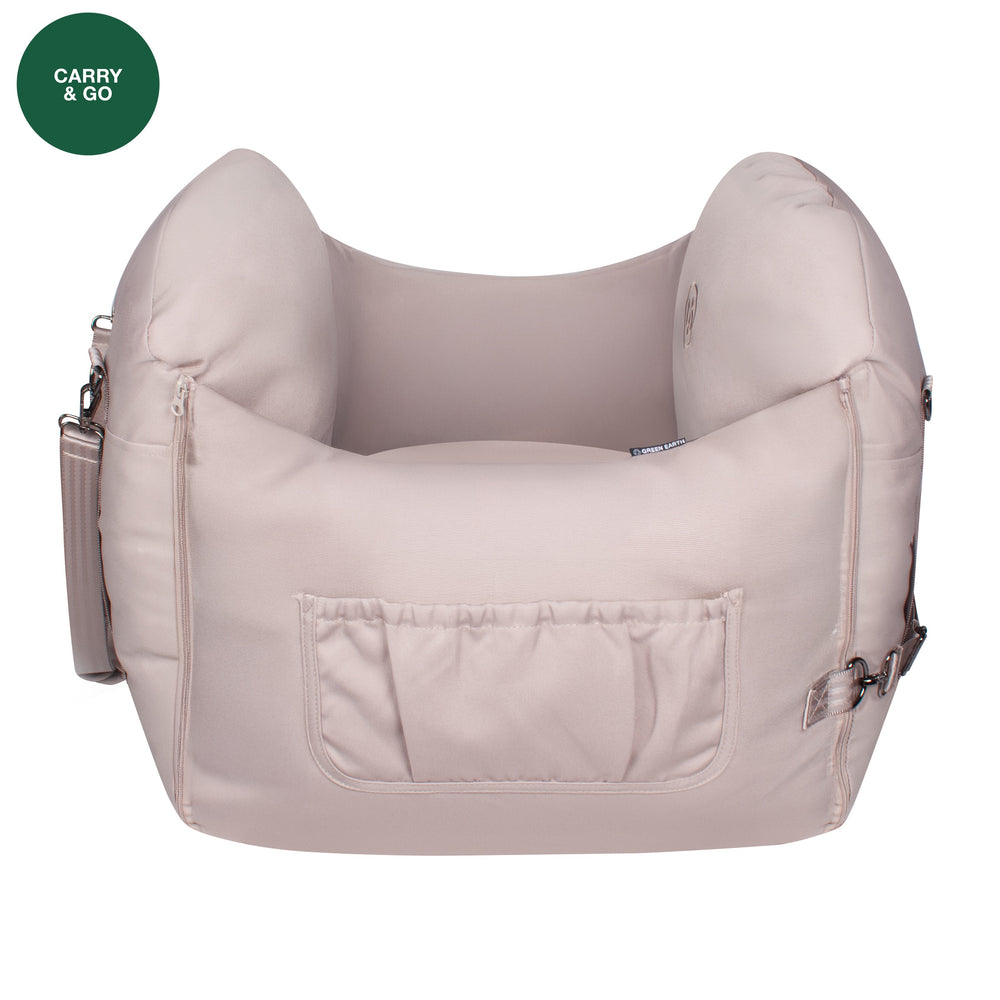
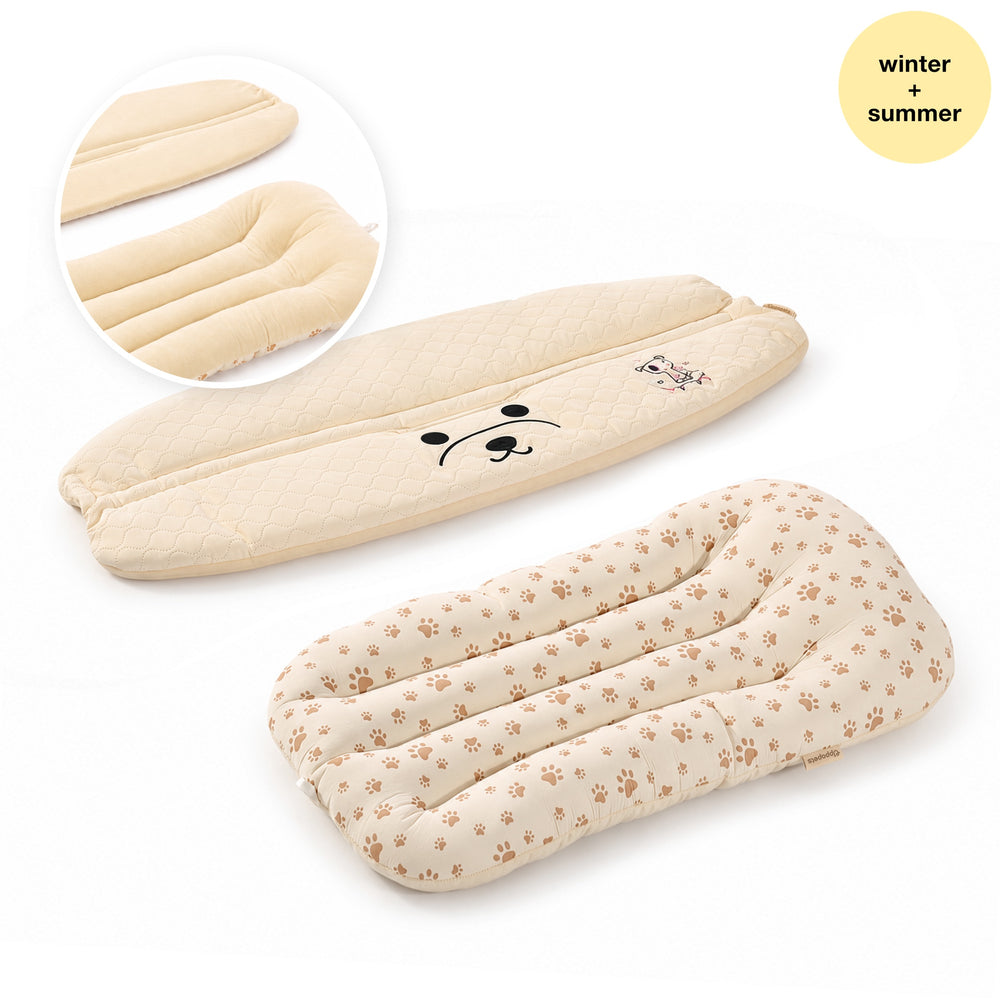

If there is an unused baby pram in the garage, it is understandable to wonder whether it could give your dog a place to ride. The wheels, handle and folding frame look familiar. But a baby pram's weight limit and appearance do not establish that it is suitable for carrying a dog.
Use a product in line with its manufacturer's intended purpose and instructions. Unless the manufacturer explicitly supports pet use in an approved configuration, do not assume a baby pram can be converted safely with a cushion, added lead or mesh cover. A purpose-built pet stroller should still be assessed carefully for your dog's size, behaviour and the way you intend to use it.
The useful comparison is the passenger space and containment arrangement. Dogs move, turn, lie down and respond to the world differently from a seated child. That changes the questions you need to ask about the cabin, restraints, openings and access.
In this guide
- Similar frames can carry very different passengers
- Compare the passenger space, feature by feature
- Why the resting surface matters
- A child harness and a pet attachment do different jobs
- Look at the whole enclosure, including the small gaps
- Plan how your dog gets in and out
- What baby-stroller manufacturing experience contributes
- A few pet-specific choices within the Uppapets range
- You may already have a suitable alternative
- Questions about baby prams and pet strollers
Similar frames can carry very different passengers
A folding chassis, canopy and handle can appear in both product categories. The similarities make sense: both need to be pushed, parked, folded and stored. They do not make the passenger systems interchangeable.
Baby prams and strollers vary considerably. Some have bassinets, some have shaped seats and some accept approved attachments. Pet strollers also vary: there are integrated cabins, detachable carriers and larger formats. Avoid treating either category as a single design.
The ACCC Product Safety description of baby prams and strollers concerns products designed to transport a child. Compliance with a baby-product standard should not be treated as separate approval to carry an animal or to modify the product for that purpose.
Compare the passenger space, feature by feature
| Question | What to check on an existing baby pram | What to check on a purpose-built pet stroller |
|---|---|---|
| Intended passenger | Does the manufacturer explicitly permit the proposed pet configuration? | Which pets and uses does the model support? |
| Resting surface | Is this an approved arrangement for a dog, rather than an improvised padded seat? | Is the usable base large enough for comfortable sitting, turning and lying? |
| Restraints | Is there an approved pet-restraint arrangement? A child harness is not evidence of one. | What harness attachment points and instructions are provided? |
| Openings and containment | Are there accessible gaps or routes out in the proposed configuration? | How do the doors, mesh, canopy and closures work together? |
| Loading | Is there an approved way to put a dog into and out of it? | Which openings are intended for loading, and what lifting is required? |
| Limits | Do the stated limits apply to the proposed use? | What are the pet, carrier, storage and carrying limits? |
The table is a comparison checklist, not a set of conversion instructions. If the intended-use question cannot be answered, adding accessories does not resolve it.
Why the resting surface matters
Your dog needs a space that supports the way they will rest during the outing. A shaped seat intended for a child may not provide that arrangement. Filling contours or gaps with towels can create a surface that looks flatter without establishing an approved, stable base.
Check the actual usable dimensions of a pet cabin. Measure your dog comfortably, including the space used when lying and the height needed when sitting. Compare those measurements with the interior and the canopy position you plan to use.
Do not choose by kilograms alone. A long-bodied dog might be below the weight limit but too long to settle comfortably. Thick extra bedding also reduces the space above and around the dog. Use only additions that are compatible with the product instructions.
The Uppapets measuring guide explains how to collect the measurements. Start there before deciding whether you need a small integrated cabin, a detachable carrier or a larger stroller.
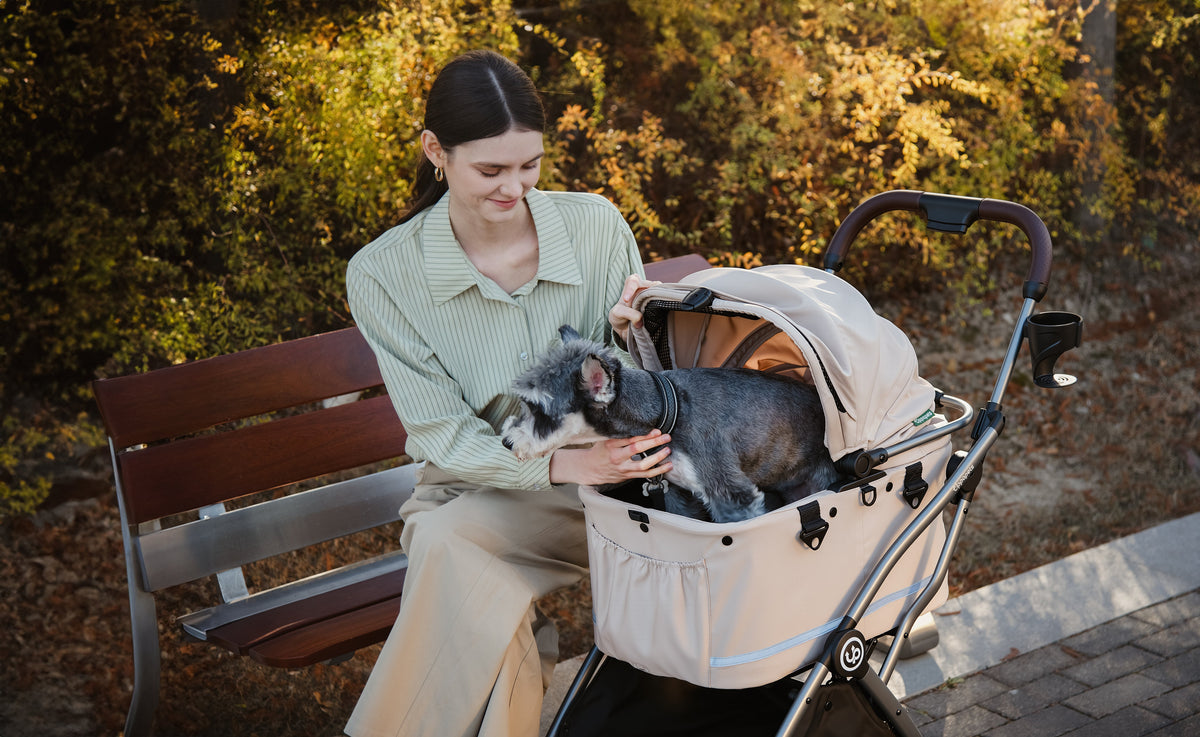
A child harness and a pet attachment do different jobs
A baby's harness is designed for the product's intended child passenger. Do not assume it can be rearranged around a dog, or that a lead clipped to the frame creates a suitable substitute.
A pet stroller should provide clear instructions for securing the pet using the intended attachment arrangement. Use a suitably fitted pet harness and the attachment method specified for the model. Do not attach a tether to a canopy bar, accessory loop or another part of the frame that is not designated for it.
Check the dog's permitted movement in the complete setup. They should be able to use the cabin as intended without a restraint becoming tangled or leaving them able to jump out and hang from it. Follow the model's guidance on tether length, attachment and enclosure use.
Restraints and enclosure features work as parts of a system. Neither is a reason to leave a dog unattended or to describe a stroller as escape-proof.
Look at the whole enclosure, including the small gaps
The canopy's appearance is only one part of containment. Examine the openings, seams, mesh, closure points and the areas around the base. A dog's nose or paw can reach places a product photograph does not make obvious.
Different pet-stroller models use different mechanisms. Some use zips, others use different canopy closures, and some have more than one type of opening. The mechanism's name does not establish security on its own; it needs to be used and maintained as instructed.
Keep mesh and closures clear of bedding, straps and accessories. Inspect the components for damage and confirm that the enclosure works properly before use. An improvised cover on another product should not be assumed to provide the same function as an enclosure designed and instructed as part of a pet stroller.
For more detail, see our guide to pet-stroller zips, mesh and closures. The focus is practical inspection, rather than assuming one style is always superior.
Plan how your dog gets in and out
A stroller is only convenient if loading and unloading are manageable. Look at the actual entry opening and the height you need to lift over, rather than assuming that a larger cabin means easier access.
Follow the manufacturer's instructions for parking, securing the frame and loading your pet. Keep the dog clear of moving parts when folding or adjusting the product. Do not lift an occupied stroller or detachable cabin by a handle unless that handle and use are specifically approved.
If your dog has health-related lifting restrictions, ask your vet how to manage the transfer. The stroller cannot solve an unsuitable lifting arrangement just by providing a comfortable place once the dog is inside.
A detachable carrier adds another option, but it also adds a carrying task. Check the separate carrier weight, carrying limit and instructions. The complete stroller's weight does not tell you how heavy the detached carrier will be with your pet inside.
What baby-stroller manufacturing experience contributes
There is a useful distinction between applying manufacturing experience to a pet-specific product and repurposing a finished baby pram.
The Uppapets brand history describes 20 years of baby-stroller manufacturing experience behind the team and the launch of Uppapets in 2021. The pet range has developed around pet use and feedback. Our strollers are manufactured in China, while Uppapets Australia is the Australian-owned business providing local customer service and access to replacement parts.
That background is relevant to the design and manufacturing story. It should not be read as permission to use the products interchangeably, or as proof of a particular certification without checking its exact scope. The cabin, restraints, capacity and instructions for the actual model remain the deciding evidence.
In practice, look for concrete features that help your routine: a manageable fold, suitable cabin dimensions, clear attachment instructions, functional brakes and useful product information. Those details make the manufacturing story meaningful to the person taking the next walk.
A few pet-specific choices within the Uppapets range
If you decide a purpose-built pet stroller is appropriate, begin with the passenger and then choose the arrangement. These examples use published specifications checked on 20 September 2026.
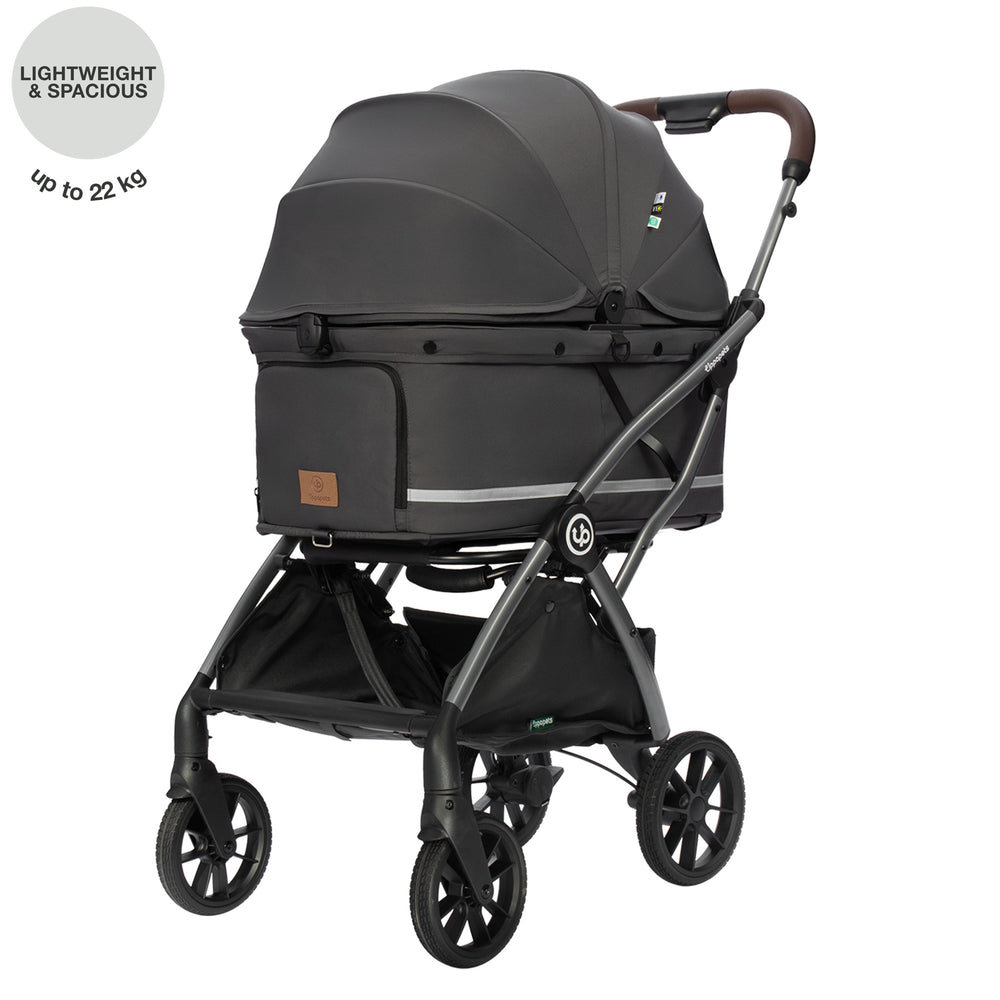
- Hybrid: a fixed carrier with a 22 kg maximum pet weight and an 8.4 kg complete stroller weight. Listed carrier dimensions are 61 × 34 × 24 cm.
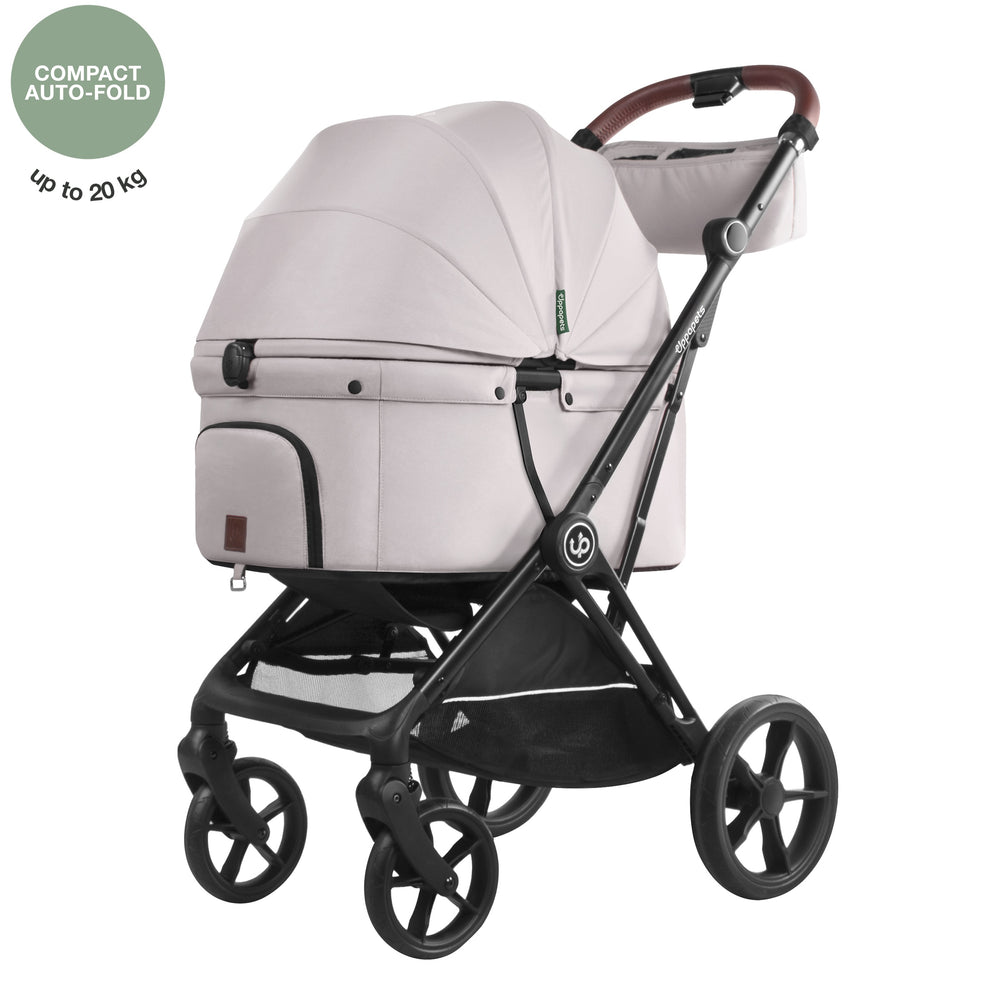
- Nero Plus: an integrated cabin with a 20 kg maximum pet weight and a 9.5 kg complete stroller weight. Listed carrier dimensions are 60 × 34 × 24 cm.
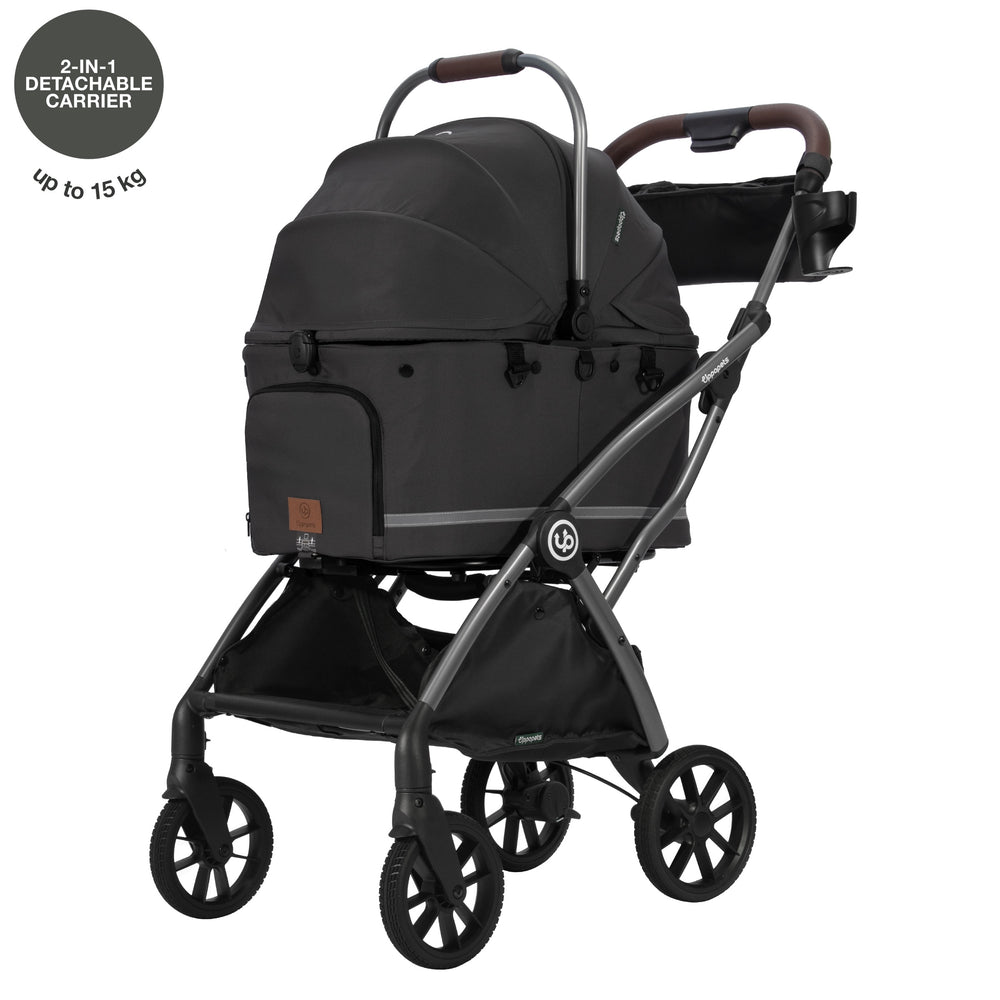
- Flander: a detachable 2-in-1 carrier with a 15 kg maximum pet weight and a 9.6 kg complete stroller weight. Listed carrier dimensions are 52 × 34 × 24 cm.
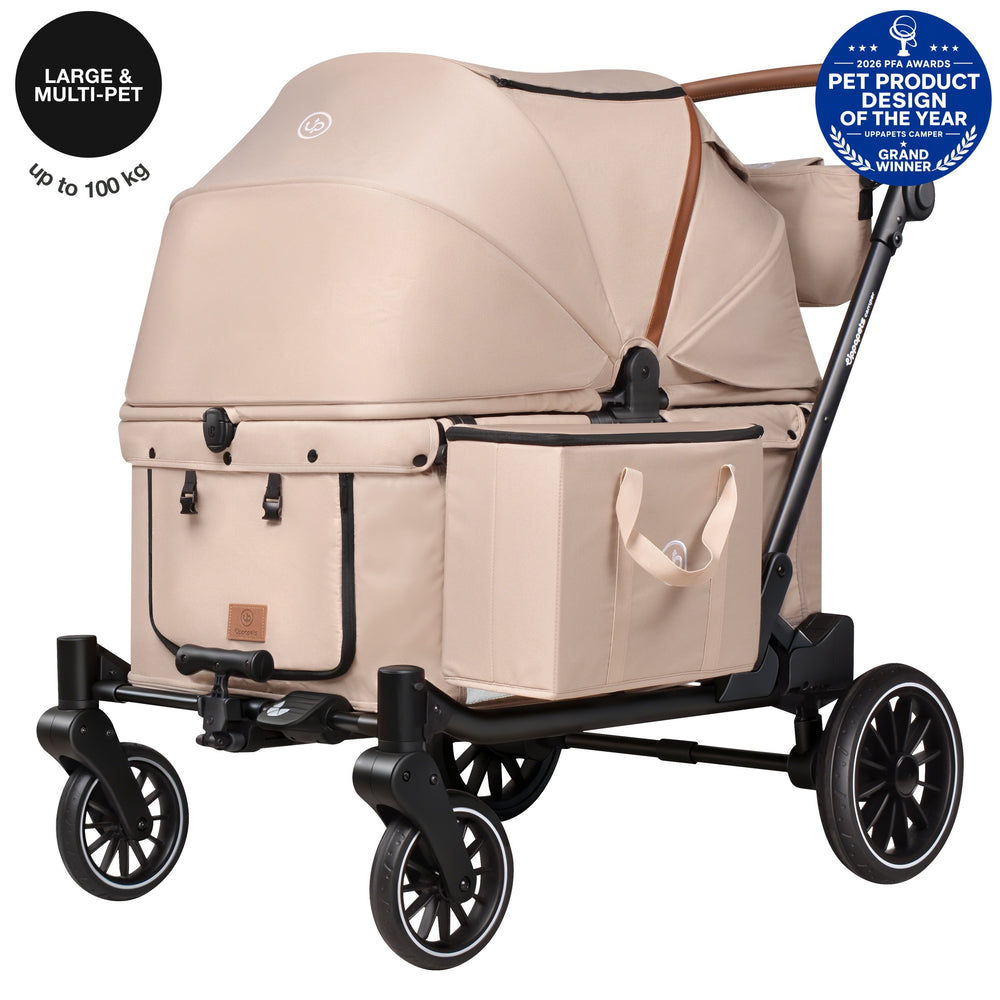
- Camper Max: a larger cabin listed at 82 × 46 × 70 cm, a 100 kg maximum pet weight and a 21.3 kg complete stroller weight.
Dimensions are length × width × height. For the first three models, confirm usable enclosed headroom rather than treating the 24 cm carrier measurement as the height under the canopy. For multiple pets, the maximum weight is their combined weight, and each still needs comfortable space.
Flander's detachable format may be useful when you want the cabin separately from the frame. Camper Max may be worth exploring when the larger cabin is needed. Neither is automatically the right choice without checking fit and handling. The range comparison brings the current details together.
You may already have a suitable alternative
The decision does not have to begin with buying a stroller. For a short journey with a small pet, an existing purpose-built carrier may already do the job if it is suitable for the pet, the journey and the person carrying it.
For a dog that is comfortable with an ordinary walk, you might simply choose a shorter route. For health-related limits, let your vet's advice guide the activity and transport plan. A stroller is useful when it solves a real need, rather than being a required accessory for every dog.
If you do choose one, give your dog time to get used to it. The RSPCA recommends gradual positive familiarisation with a transport carrier. Our first-ride guide applies a gentle introduction to the stroller routine.
Questions about baby prams and pet strollers
What if my dog weighs less than the baby pram's limit?
That does not establish suitable use. A weight limit applies within the product's intended configuration and instructions. It does not answer questions about the dog's restraint, position, containment or movement.
Can I make it suitable with a cushion and an added lead?
Those additions do not establish manufacturer approval or resolve all the design questions. Use only an explicitly approved pet configuration, or choose a product intended for your pet and use case.
Can a baby ride in a pet stroller?
Do not use a pet stroller to transport a child. Choose a child-transport product intended for that purpose and follow its instructions.
Is a detachable pet carrier automatically a car seat?
No. Detachment from the stroller frame does not establish suitability for occupied vehicle travel or crash protection. Use a transport arrangement designed for the journey, with its own instructions and any relevant verified approvals.
What is the main thing to remember?
Choose by intended use and the needs of the passenger. A familiar-looking frame can hide very different cabin and restraint arrangements. Clear instructions, a comfortable fit and a manageable daily routine provide a firmer basis for the decision than appearance or weight capacity alone.
Find their ride