
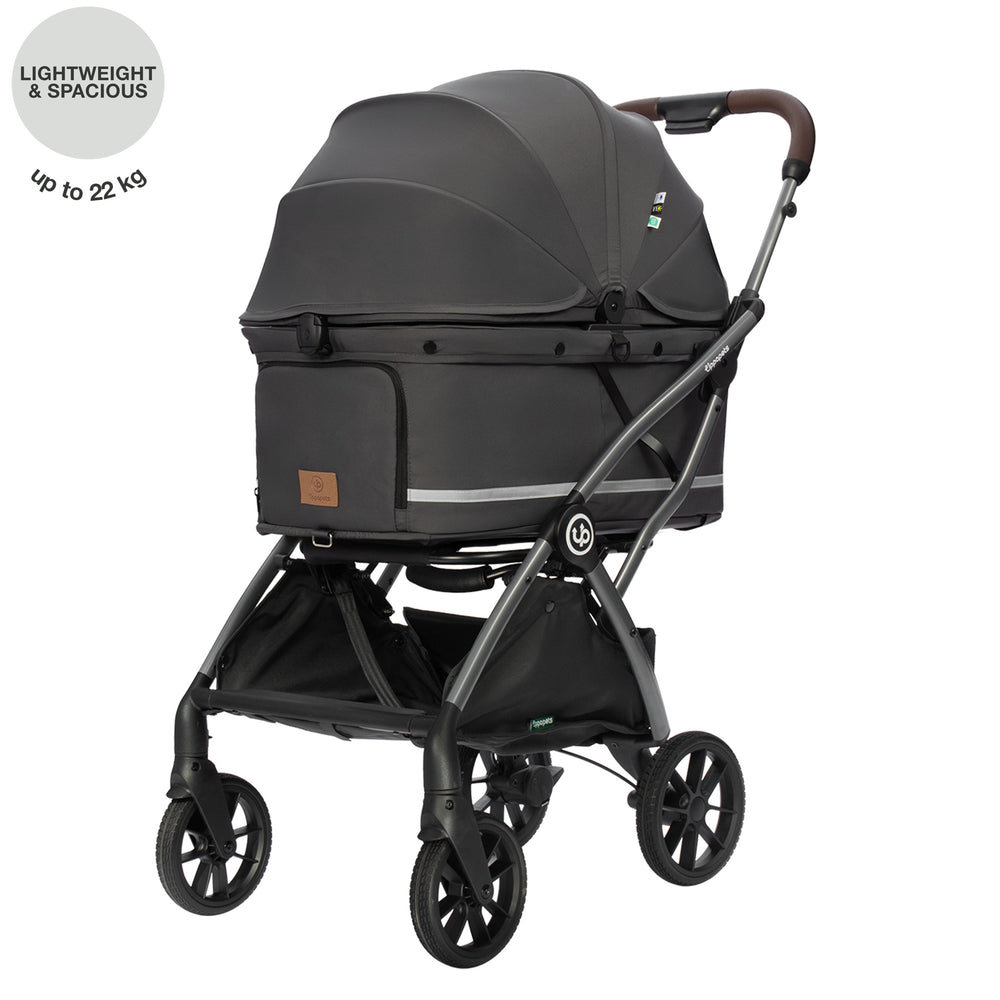
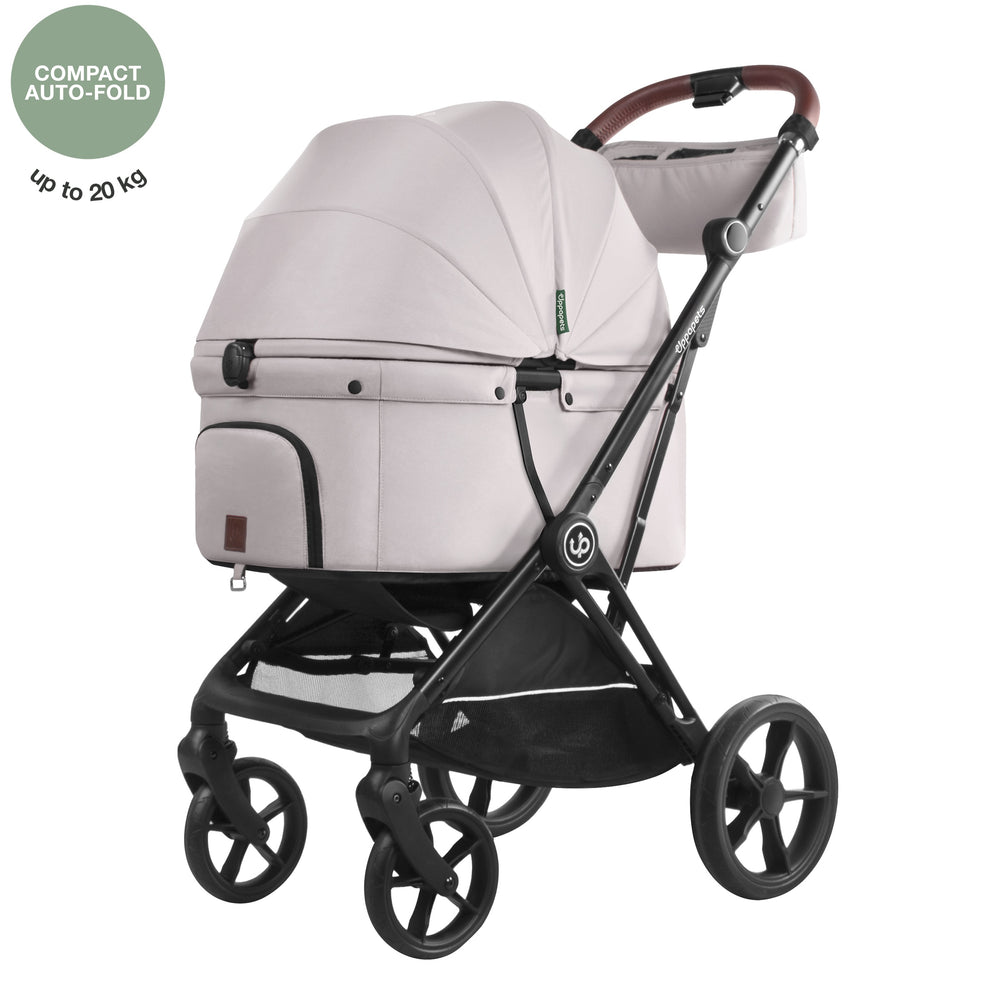
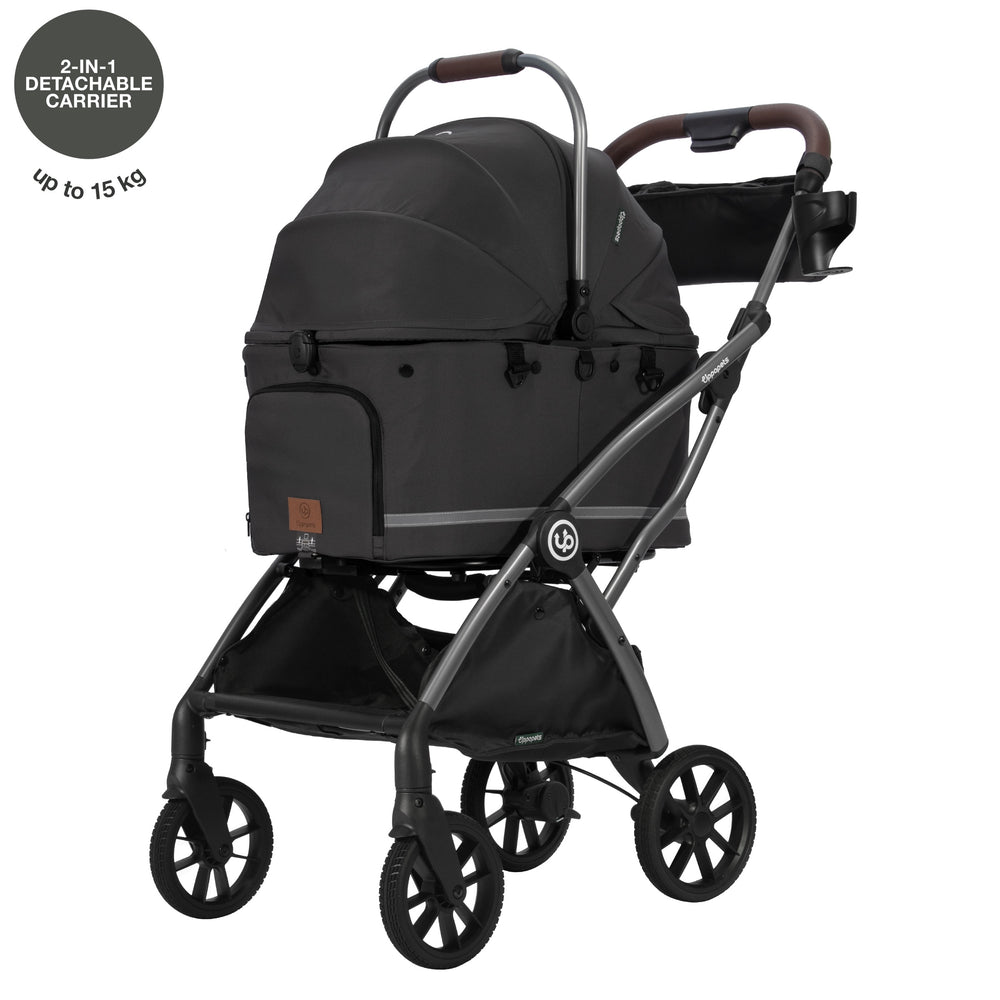
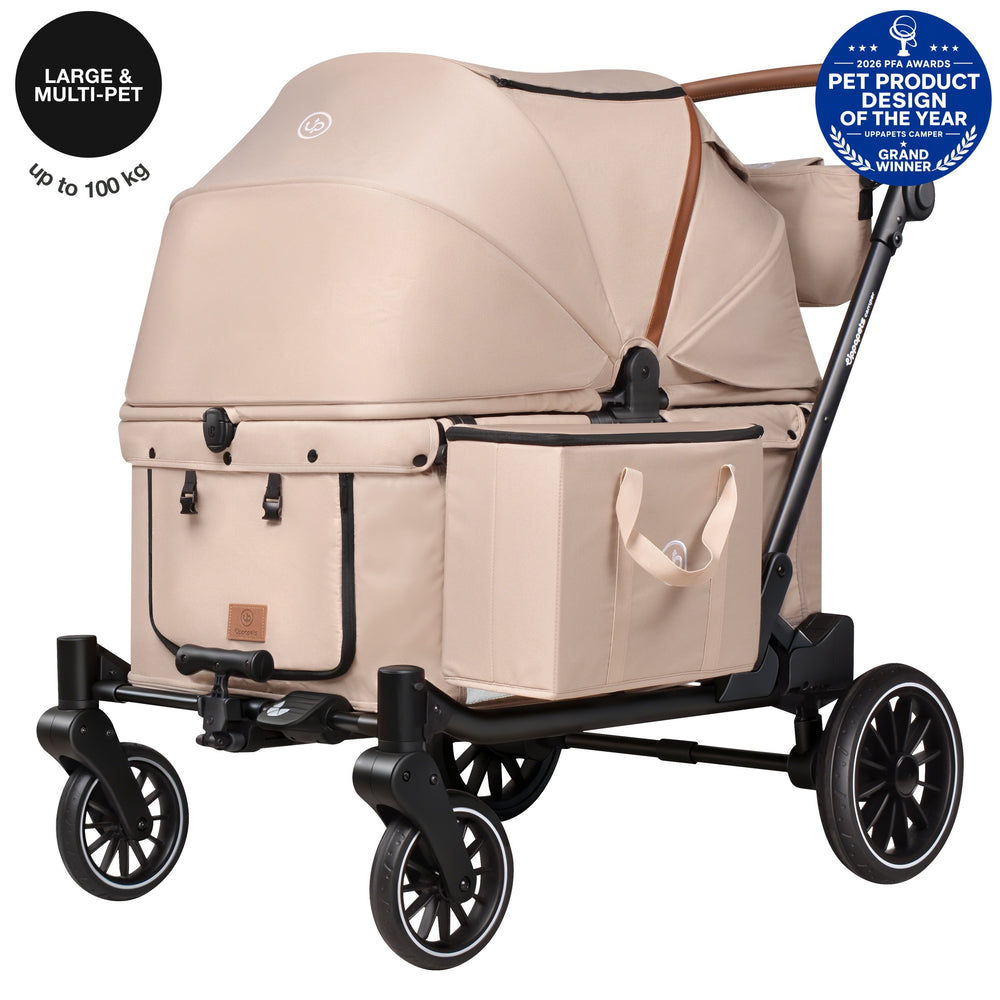


A stroller outing can include the familiar things you both enjoy: a little exploring, time together along a pleasant path, and a stop before heading home. Walking and riding can have different jobs within that plan.
For a dog who is suited to a stroller, the useful question is how to arrange the outing around their individual needs. That might mean an appropriate walking section and a riding section, or a different arrangement advised by your vet.
Here is a practical way to plan a mixed outing without treating distance, duration or the amount of walking as a target to achieve.
In this guide
- What can walking and riding each contribute?
- Begin with what already works for your dog
- Build the route from manageable sections
- Make changes between walking and riding an ordinary part of the plan
- An illustrative outing plan
- Plan opportunities to explore, rather than racing between them
- Do not wait for the outing to become difficult
- Weather changes the whole plan
- Keep the routine easy enough to repeat
- Review the outing with a few useful observations
- Questions owners often ask
What can walking and riding each contribute?
Walking gives a dog the opportunity to move and explore on the ground when appropriate for them. Riding provides transport through a section of the outing. Sitting in a stroller does not provide the same physical activity as walking.
RSPCA WA explains that exercise needs vary with age, breed, health and personality, and that enrichment gives dogs opportunities to explore and sniff. Ask your vet about the right activity for your dog if you are uncertain. RSPCA WA's guide to caring for a dog.
Use the stroller to solve a defined transport or participation need. Keep your dog's appropriate movement and other activities in the overall routine rather than assuming time outside automatically meets every need.
Begin with what already works for your dog
Before making a new route longer, describe a current outing that goes well. Where do you go? What do you do? Which parts seem enjoyable? What preparation makes the trip easy to manage?
That familiar arrangement is a useful starting point for adding an already-introduced stroller. You can learn about one change without also changing the destination, surfaces and amount of activity.
If your dog's capacity or behaviour has changed, obtain veterinary advice before experimenting. If they already have an activity plan, use that as your boundary. Riding is not a reason to extend the outing beyond what has been agreed.
Build the route from manageable sections
Instead of planning one uninterrupted loop, draw the outing as a few simple sections. Each should have a purpose and an easy way to shorten the plan.
| Section | Planning question | A practical detail to check |
|---|---|---|
| Leaving home or the car | How do we get started without rushing? | A clear, level place to prepare the stroller and dog |
| Walking section, if appropriate | Where can my dog move and explore comfortably? | Suitable footing and room to manage both lead and pram |
| Riding section | What specific part of the route does riding help with? | Surfaces and gradients consistent with the product's instructions |
| Quiet stop | Where can we pause without being crowded? | Space out of the main flow of people and dogs |
| Return | How can we finish early if needed? | A short alternative route and a workable transfer |
There is no required order. The first section might involve riding to a suitable place. Another dog might have a brief appropriate walk near home and ride for a planned section afterwards. Individual needs should determine the arrangement.

Make changes between walking and riding an ordinary part of the plan
A good transfer place is worth identifying before you leave. Look for enough room to stop clear of traffic and other people, with a surface suitable for parking the stroller as directed.
Follow the product instructions for the brake, frame locks, enclosure and restraints. Keep control of your dog while moving between their walking lead and the intended riding setup. Do not create an unsecured moment because you are trying to manage too many things at once.
Think about who will do each task if you are out with another person. If you are alone, consider how you will manage the dog, pram and any bags without improvising on a narrow footpath.
Entry and exit also need to suit the dog. Where health or mobility issues affect transfers, ask your vet for guidance on handling. Never assume that a dog can safely jump in or out because the opening looks accessible.
An illustrative outing plan
Imagine an owner whose dog is already comfortable with a suitable stroller and has an established activity routine. They would like to share a quiet morning beside a familiar park. This example is a planning exercise, not a recommended exercise prescription.
The owner chooses a route with a level return and an easy shortcut. They identify a suitable area for any walking permitted in the dog's routine and a separate section where they intend to use the stroller. Their destination is simply a quiet place to pause together.
Before leaving, they check conditions and decide whether the outing is appropriate that day. During the trip, they remain willing to shorten it. A crowded path or an unsettled passenger is enough reason to change plans.
The measure of success is not how far they travelled. It is whether the arrangement worked comfortably for the dog and was manageable for the owner. Next time, they can repeat the parts that worked and change the parts that did not.
Plan opportunities to explore, rather than racing between them
When walking is appropriate, leave room in the plan for the dog to investigate their surroundings at a suitable pace. A route built entirely around reaching a destination can make every stop feel like a delay.
Choose a smaller outing if that gives you more time to enjoy the parts your dog values. You do not need to cross a whole park to have a worthwhile morning together.
For a dog whose vet has set specific activity or exposure restrictions, ask how those opportunities can fit within the plan. Avoid adding ground time simply because a general article recommends it; individual instructions come first.
Do not wait for the outing to become difficult
Plan the riding section from your dog's known needs and any professional advice, rather than making exhaustion the signal to switch. Leave yourself enough flexibility to finish earlier than expected.
If new limping, unusual reluctance or discomfort appears, stop the activity and seek veterinary advice. A ride home may be part of getting out of the situation, but it does not explain the change or make continuing the social outing appropriate.
Similarly, if your dog is unsettled in the stroller, adding more movement or distance is not the next step. Stop safely and choose a simpler arrangement. The purpose of bringing options is to use them when the plan needs to change.
Weather changes the whole plan
A canopy and a riding option do not make hot conditions safe. RSPCA Australia identifies heat, humidity, poor airflow and lack of shade or water as relevant risks, and recommends avoiding hot surfaces and exercising at cooler times. RSPCA guidance on preventing heatstroke.
Choose the outing around conditions rather than trying to preserve a schedule at all costs. If the day is unsuitable, change the time, destination or activity. Do not drape coverings over the stroller in a way that restricts ventilation.
Rain and wind can also change how manageable a route is. Consider the instructions for any weather accessories and the conditions along the return route. Getting out together should not depend on pushing through a plan that has stopped making sense.
Keep the routine easy enough to repeat
An elaborate outing can look appealing but be hard to use regularly. Before committing to a destination, check the small practical details:
- Where will the folded stroller live between trips?
- Can you get it through the doorway or into the car without rearranging everything?
- Is water, waste collection and other necessary equipment easy to carry within the product's storage limits?
- Can you operate the brake and steer comfortably?
- Will the chosen stopping place have enough space?
- Can you return directly if either of you needs to finish?
For a car-based routine, our boot-fit guide helps you assess the journey before the walk even starts.
Review the outing with a few useful observations
Afterwards, write down what would make the next trip easier. Keep the notes descriptive rather than turning the dog's behaviour into a score.
“The narrow gate was awkward with the pram” tells you to change the route. “The seating area was crowded” tells you to reconsider the stop or timing. “The transfers took longer than expected” tells you to allow more room and preparation.
Record anything unusual about your dog's comfort or movement too, and discuss concerns with your vet. The notes help you distinguish a practical planning issue from something that needs professional assessment.
Keep successful routes simple enough to repeat. Familiar places can still offer a worthwhile shared outing; novelty is not a requirement.
Questions owners often ask
Will a stroller make my dog lazy?
The useful question is whether their overall routine continues to meet their individual needs. A planned riding section can coexist with appropriate activity. Using transport as a replacement for needed exercise is a different arrangement and should not be assumed suitable.
How many minutes should my dog walk before riding?
There is no universal interval. Base the plan on your dog and seek veterinary guidance where needed. A timetable copied from another dog is not a reliable activity prescription.
Can I make my own walk longer while my dog rides?
Only if the complete outing is suitable for your dog too. Consider their comfort, conditions, access to appropriate breaks and any individual restrictions. Your preferred distance should not decide the dog's tolerance.
What if I have two dogs with different needs?
Plan for each dog separately, including who manages them and how transfers happen. A riding option may be useful, but a shared outing should not force either dog into an unsuitable arrangement. Separate activities remain a valid option.
Which stroller features matter for this kind of routine?
Start with passenger fit, safe transfers and practical handling on your intended route. Then consider storage and transport. Use the Uppapets comparison page alongside your route notes to choose around the outing you actually want to share.
Find their ride